

Immanuel Lutheran Communities couldn’t run without its staff.  This seems like an obvious statement.  But we don’t want it to leave it at that; we want to recognize the people who go out of their way to make seniors’ lives better.  And we want to do it by making their lives better.

Our community is full of women and men who work hard, every day, to make Immanuel a wonderful place to live.  Everyone from housekeepers to nursing assistants to dining room servers knows the residents, their needs, and their preferences.  Just yesterday I got to eat lunch with my grandfather in the Claremont Restaurant, and I was delighted (though not surprised) to observe just how much Rachel, our server, knows about his preferences.  He didn’t even have to ask for his hot chocolate or his black cherry frozen yogurt.  She knew what he would want, confirmed it, and brought it.

I am telling you this story because it shows the small ways in which our staff members work to make our residents feel special, and it shows how special our staff members are.  We recognize the contributions these special people make partly by helping them pay for school.

Like all retirement communities, Immanuel relies on a large contingent of lower-paid staff, including CNAs, housekeepers, and maintenance technicians as well as servers like Rachel.  Many of these employees would like to grow in their professional lives, so the opportunity to get some help paying for education helps them make the changes they want to make.  Money from the Employee Education Fund has helped CNAs to become LPNs, LPNs to become RNs, employees in other departments to gain credentials in a wide variety of fields.  Many of them choose to stay and work at Immanuel, and they continue to provide superb customer service and care to the residents who call this community home.

Lately, so many employees have chosen to apply for education funding that we are not able to fund all requests at full capacity.  We would like to help our employees more, and to that, we need help from you.  By designating your gift to the employee education fund, you can make a difference in the lives of those who make a difference to our residents every day.

I have something to confess.  I was an English major.  (Oh no!  You gasp.  Everyone knows humanities majors are weird.  I guess since you’re the grant writer it’s okay?)  But, it’s even worse than that.  I went to grad school in English and I hold a Ph.D.  I even taught for a few years after finishing.  In the midst of a career change like this, it’s easy to think that none of what I learned in all those years of education will be useful.  But I often find myself making connections between some of the most abstract topics I’ve studied and day-to-day life in a retirement community.

One of the most striking of these connections has to do with structural linguistics as outlined by French philosopher Ferdinand de Saussure.  Structuralism actually has a lot of applications to everyday life (just trust me), but the one that’s been on my mind lately has to do with dementia.  For a lot of reasons, dementia is difficult and scary for the person experiencing it and the people observing the change.  One day awhile back a colleague told me about a resident who, at dinner time, tried to eat her soup with her fork instead of her spoon.   At first, I thought this was just sad and frankly kind of weird; after all, the resident remembered that utensils are for eating.  But then I started thinking about this story using a structuralist lens.  My fellow English majors—at least those who studied theory—are probably nodding their heads, but the rest of you might be wondering what on earth I’m talking about.  That’s okay.  If you’ll bear with me, I’ll explain—and then, I promise, I’ll also explain what it has to do with dementia.

Saussurian structural linguistics posits that language is composed of signs.  To simplify radically, a sign is a word.  But in structural linguistics, a word is more than a collection of letters.  Signs consist of both the collection of letters (say, “chair”) and the concept behind the collection of letters (so, a thing used primarily for sitting on, with four legs, a seat, and probably a back).  Saussure called these two parts the “signifier” and the “signified.”  Every sign is comprised of both a signifier and a signified, and the two parts are inseparable (try thinking of a chair without thinking of the sounds and letters c-h-a-i-r; you almost certainly can’t).  We understand each other when we talk because we all agree on which signifiers match which signifieds.  Because signs aren’t just words, we also know what to do when we encounter their physical manifestation; we sit in chairs.

Saussure also described the concept of sign systems.  All languages are sign systems, and there are sign systems that aren’t languages.  In systems, signs are arbitrary and relational.  Which is to say, there’s no reason why c-h-a-i-r is a thing we sit on accept that it always has been.  Also, we understand chairs in relation to tables, stools, couches, and other items in the general sign system “furniture.”  Chairs are different from all of these other things, and we know what chairs are for, and therefore what the sign “chair” means, in no small part because we understand how they are different from other things.

You might well ask, “What does all this have to do with a resident eating soup with a fork?”.  Well, the resident still understood the sign system “utensils.”  What she didn’t understand was the specific sign “spoon” and how it differs from “fork.”  As dementia progresses, we lose our understanding of specific signs before we lose our understanding of sign systems.  In this instance, academic theory I studied in the past helped me make sense out a confusing event in my present.  Structuralism is a way of understanding language and our relationship to it, and it can also help us understand the process we undergo when our understanding of language breaks down.

I had the pleasure of spending much of last week with photographer Heidi Wagner.  Heidi’s photo series The Passions Project aims to change the face of aging by highlighting all the positive, productive ways in which seniors spend their time.  We were excited to have her on campus, and we can’t wait to see the photos she took of Immanuel residents during our 20 sessions.

One of the best things about the week was that I got to learn more about some of the residents here at Immanuel.  Over the course of the week, I talked with a three painters, two pianists, a woodcarver, a restorer of classic cars, and a stamp collector, among many others.

Some of the residents my colleagues and I talked with continue to pursue their passions as avidly as they ever did.  The philatelist, for example, keeps adding new stamps to her album and attends monthly meetings of the local stamp club.  For others, it’s gotten hard or even impossible to do everything they used to.  The restorer of classic cars no longer has either the physical capacity or the appropriate workspace to continue his work, and the woodcarver has developed a health condition that makes it unsafe for him to use sharp blades.  But that doesn’t mean they’ve lost their passions.  Their eyes still light up when they talk about these activities, and they’re still able to share the knowledge they gained over years of pursuing them.

I’ll admit, it was a busy and somewhat draining week.  After three to five interviews and photo shoots, I certainly went home every evening ready to put my feet up!  But it was fun to talk to people about their passions, and I learned so much about residents I’ve known in some cases for a couple of years.  I also made some amazing new acquaintances and learned about what they love—and, in some cases, about their personal histories.

I’m excited to share with you some of what I learned last week about twenty remarkable individuals. Once we have the photos, I’ll share some of those, too.  What The Passions Project shows is that we don’t have to stop pursuing our passions as we age, and that passions don’t stop being passions just because we can’t engage in them in the ways we once did.

If you’d like to see The Passions Project photos in person, don’t forget to mark your calendar for the opening reception at 5:30pm on Thursday, October 11 at Buffalo Hill Terrace.

From hiking to painting to writing to spending time with pets, we all have things we love to do.  When asked how we want to spend our time when we retire, I think most of us would say that we want to be doing the things we love most and spending time with the people we love most.

However, there seems to be a perception out there that as we age, we stop doing the things we love, and that maybe we even stop loving the things we used to.  While it’s true that our interests and abilities change, we can continue to find joy in the things we’re passionate about—and we can even develop new passions.

This year, Immanuel Lutheran Communities is participating in The Passions Project, a photo series showcasing seniors pursuing their passions.  We’ve selected twenty residents to be photographed, and we’ll use these photos around campus and, we hope, around town.  We want to change the face of aging in the Flathead Valley.

As you learn more about the Passions Project in the coming weeks, I encourage you to think about what you want to be doing in the latter years of your life.  Will you hike more?  Read more books?  Travel the world?  Or maybe, like some the Passions Project featured residents, you’ll discover a new passion!

Today I’d like to share a story that Hannah, our Recreation Director for Independent and Assisted Living, told me about something that happened in her department.  Each year at Easter, the Recreation team offers residents and staff the opportunity to purchase “Bunnygrams.”  For $3, a bunny-suit-clad Recreation team member will deliver a chocolate bunny and an Easter greeting to any resident or staff member the purchaser chooses.  The proceeds from Bunnygrams go to the Resident Care Fund.
Several weeks before Easter, just after the Bunnygram announcement went out, Polly and Peter—both independent residents–stopped by Hannah’s office.  Between them, they purchased Bunnygrams for all 24 residents in the Lodge at Buffalo Hill, our Memory Support community.

Polly and Peter both have personal experience with people with dementia.  Polly was a caregiver to someone with Alzheimer ’s disease, and Peter is a retired pastor who has counseled numerous families.  He’s also had close friends with dementia.  They know from experience how much little things matter in the daily lives of those with memory loss, and they took it upon themselves to provide one of those little things.  By giving Bunnygrams, Polly and Peter gave moments of joy to 24 people who are experiencing one of the most difficult effects of aging.

But the care Polly and Peter exhibited with the Bunnygrams goes beyond the Lodge.  At the same time they gave moments of joy to the Lodge residents, they gave nearly $50 to the residents of the Skilled Care Center (enough to cover unreimbursed Medicaid costs for one resident for one day).  Their small act of generosity flows through our entire community.  Polly and Peter bought Bunnygrams because they cared about the Lodge residents, and because Hannah structured the program with philanthropy in mind, the whole community benefits.

Polly and Peter’s generosity is just one example of the caring community we’ve built here at Immanuel.  Everyone from the staff who conceived of the Bunnygrams to the residents who purchased them in bulk thought carefully about how to make the lives of others better.  Small moments of joy matter, and a small gift can make a big difference in the lives of those who live here.

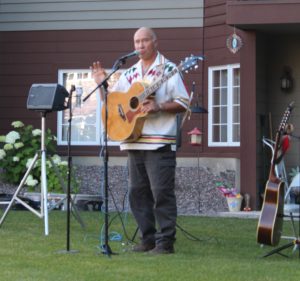
Immanuel Lutheran Communities’ annual Summer Concert Series for 2018 kicked off on Wednesday, July 11 with a wonderful performance by storyteller and singer/songwriter Jack Gladstone.  The Buffalo Hill Terrace courtyard was full of residents, families, and guests of all ages.  Over the years, these concerts have become events where the wider Flathead Valley community joins the Immanuel community for music, snacks, and socialization during our beautiful Flathead Valley summers.

Many of our residents still enjoy going out to events and performances.  However, it’s hard for others to go to as many events as they’d like.  Getting in and out of the car can be difficult, and some venues aren’t very senior-friendly because of stairs, uncomfortable or wrong-height seating, or long distances between parking and event space.  So when we bring artists to campus, we bring live music to residents who couldn’t hear it otherwise.

But the concerts are about much more than that.  Last night, many residents had family members present.  In fact, my own parents were there with my aunt, visiting my grandfather (a Buffalo Hill Terrace resident).  They were far from the only ones; the crowd ranged in age from elementary-school-aged children to some of the Terrace’s oldest residents—who are approaching 100!  The outdoor summer concerts allow for easy mingling and snacking while listening to the music.  This makes it an ideal environment for families who want to spend time together.

The Summer Concert Series is also about our connection with the wider Flathead Valley community.  We advertise these concerts widely, and people with no prior connection to our campus sometimes visit us for the first time when they come to hear a concert.  It’s a good opportunity to see how much fun a retirement community can be.  When guests visit our campus for the concerts, they see neighbors enjoying each other’s company, families getting to know the friends of their loved ones who live at the Terrace, and residents taking in the music from their patios and balconies.  Guests also get to enjoy snacks provided by our wonderful dining team (last Wednesday’s cheese ball was particularly delicious).

The Immanuel Foundation staff thoroughly enjoyed the Jack Gladstone concert (and we’re still talking about the cheese ball), and we’ll be back for all the rest.  We’d love to meet you, so be sure to stop by our table to pick up some Foundation swag and register to win a $50 Amazon gift card.  We’re also selling raffle tickets for a handmade queen-size quilt.  Tickets are $5 or $20 for five, and proceeds benefit the altar furnishings for our new chapel.

The next concert is Stick and String at 7pm on Wednesday, July 25.  We hope to see you there!

While this blog lives on the Immanuel Foundation website, it’s not really about asking for donations. Instead, it’s about sharing stories of the work we do. But Amazon Prime Day starts at 1pm Mountain Time today (more on what that is in a minute), so I thought I’d take this opportunity to write a little bit about how easy it can be to be philanthropic in the twenty-first century. Of course, we all want to be thoughtful about how we direct our gifts so we can make sure they’re going to organizations we genuinely support. So giving wisely can take a lot of time and research. But not always. Sometimes, giving is easy.

I’m thinking about this right now because July 16th-17th bring us Prime Day, Amazon’s 36 hours of discounts for members of its Prime program. If you’re thinking right now that that sounds like the ultimate made-up holiday created purely to justify consumerist excess, you and I are on the same page (but, um, we might also be on that page, trying to figure out whether there will be any good deals on things we, er, need). On its face, Prime Day doesn’t sound like much of an occasion for philanthropy.

But it could be! Immanuel Lutheran Communities participates in the Amazon Smile program. If you shop at smile.amazon.com and choose Immanuel Lutheran Communities as your designated charity, a percentage of your eligible purchases will go to help seniors in the Flathead Valley. There’s no additional cost to you, and once you’ve chosen your charity, you don’t need to do anything except start shopping at the “smile” page rather than at the regular Amazon page. Just think, you could get a great deal on a Fire TV Cube (once you figure out what that actually is) and help care for seniors!

Prime Day might, in fact, be mostly a day of buying “presents” for yourself. But simply by doing your shopping that day on Amazon Smile, you can give presents to Immanuel residents as well. Giving via Amazon Smile doesn’t cost you anything more than what you’re already paying for the items you buy. The donation comes from Amazon’s foundation to our foundation—all you do is direct it (while shopping!). I think most of us in the Flathead Valley would agree that online retailers have made it much easier for us to get the things we want and need in a timely fashion. Conveniently, they’ve also made it easier than ever to give back to our friends and neighbors here in our home community.

I’d like you to meet Delsie B.  90-year-old Delsie has lived at the Immanuel Skilled Care Center since 2014, when a stroke made it impossible for her to care for herself. Delsie is beautiful inside and out; her beautiful smile, smooth skin and well-cared-for clothes are only outshined by her positive and happy demeanor. Today, I want you to learn more about Delsie so you can get to know one of the many wonderful residents who calls Immanuel home.

Delsie was born on the Highline and was one of seven children in a Mennonite farming family.  She fondly remembers her childhood and her eyes light up as she recalls a time when she and her closest sister, Betty, fell down a snowy hill on their three-mile walk home from school.  Who pushed who is still a lively debate between the two.  After graduating from high school, Delsie moved to Glasgow.  While there, she met Bob, who had just been discharged from the army following World War II.  It was love at first sight and they married after a whirlwind two-week courtship!

Bob’s family was moving to the Flathead, and the newlyweds joined them.  At first, Delsie worked in a dress shop while Bob pumped gas.  As the years went on, they were blessed with three daughters and two sons.  Delsie ran a daycare in her home so she could bring in money while also caring for her own children.  During this time Delsie, who had always loved to draw, taught herself to paint.  Oil paint remains her favorite medium, though she’s worked in watercolors, too.  The 2017 Immanuel Lutheran Communities Christmas card featuring one of her paintings (shown above and below) is only the latest honor for her award-winning work.  Her room is decorated with examples of her artwork going back decades.

Delsie has had some hard times.  After 50 years of marriage, Bob passed away.  Since then two of her children have also passed, and another has developed serious health problems.  So when she had a stroke that made her unable to care for herself, Delsie came to Immanuel.  When asked what she likes best about Immanuel, Delsie says it has “the best people.”  She calls Keisha, her favorite CNA, “darling,” and says she’s “a lovely girl.”

Delsie’s story is unique, and every resident who lives at Immanuel has a unique story.  That’s why the Immanuel Foundation blog will regularly feature residents’ stories.  The sum total of wisdom and life experience housed at Immanuel Lutheran Communities is truly astonishing. At the Immanuel Foundation, I get to meet amazing seniors like Delsie and raise funds to make sure they keep getting the care they need, and I want you, too, to have a chance to meet some of the people your donations help.